
PRP uses concentrated platelets from your own blood. Stem cell-based treatments use cell-rich material, usually from bone marrow or fat. PRP has the larger body of research for tendon problems, but neither treatment has been shown to reliably regrow a torn rotator cuff tendon. Which one, if either, makes sense for you depends on your diagnosis and needs. Understanding these differences is important when comparing PRP vs stem cell therapy for rotator cuff injury.
What Is the Difference Between PRP and Stem Cell Therapy?
Both are called “biologic” treatments because they use material from the body, and both are usually given as an injection. Beyond that they are quite different in what goes in the syringe, how it is prepared and how much evidence stands behind it.
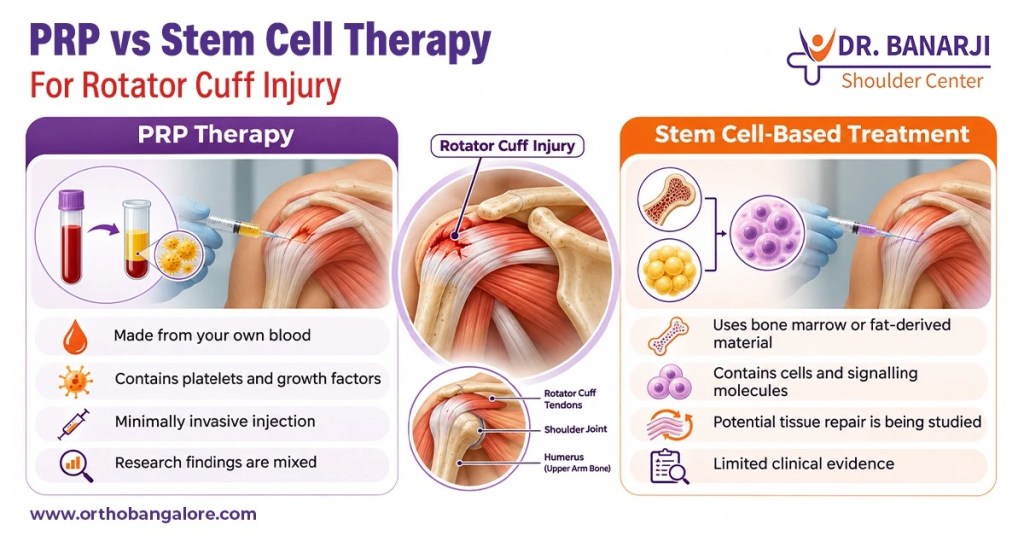
What Is PRP Therapy for a Rotator Cuff Injury?
Platelet-rich plasma is made from a small sample of your own blood. The sample is spun in a centrifuge to concentrate the platelets, and the result is injected around the injured tendon, often with ultrasound guidance. Platelets carry growth factors, and the idea is that these may influence tendon healing and ease pain. Preparations differ in platelet concentration and in whether white blood cells are included, which makes results hard to compare.
What Are Stem Cell-Based Treatments for a Rotator Cuff Injury?
These treatments use cells taken from bone marrow or fat tissue. Bone marrow aspirate concentrate (BMAC) is a common example. What is injected is usually a mixture of cells and signalling molecules, and it often contains only a small number of true stem cells. The proposed benefit is that mesenchymal stromal cells may support repair. Most of that reasoning comes from laboratory and animal work.
How Do the Two Treatments Differ?
| Comparison Factor | PRP | Stem cell-based treatment |
| Source | Your blood | Bone marrow or fat |
| Preparation | Blood draw and centrifuge | Harvest procedure, then processing |
| Proposed action | Growth factors from platelets | Cells and signals that may support repair |
| Rotator cuff evidence | Larger body of studies, mixed findings | Smaller, early-stage evidence |
| Main limits | Varied preparations, uncertain tendon healing | Few controlled trials, product variation, regulation |
How Effective Is PRP for a Rotator Cuff Tear?
The honest answer is “sometimes, for some outcomes.” Pain, function, imaging findings and surgical results need to be looked at separately, because a treatment can help one and not another.
What Does Research Say About Pain and Shoulder Function?
Some trials and reviews report modest improvements in pain or shoulder scores after PRP, especially in tendinopathy and partial tears. Other well-run trials find no meaningful gain over comparison treatments such as saline injection or exercise. A patient who feels better after PRP may also have improved with time and rehabilitation alone.
Does PRP Improve Tendon Healing?
This is less clear. Pain can improve while an MRI or ultrasound still shows the tear. Some studies suggest that PRP used alongside surgical repair may lower the chance of retear in certain situations, while others do not. The results are inconsistent.
What Are the Limitations of PRP Evidence?
PRP is not one product. Platelet counts, white cell content, volume, number of injections and technique all vary between studies, so pooling the results is difficult. Many trials are small, and patients and tear types differ widely. The recommendation from the American Academy of Orthopaedic Surgeons on this topic should be cited here, stated exactly as it appears in the current guideline.
What Is the Evidence for Stem Cell Therapy for Rotator Cuff Injuries?
The evidence is thinner than for PRP, and it needs to be read with care about what was actually injected.
What Types of Stem Cell-Based Interventions Have Been Studied?
Researchers have looked at bone marrow aspirate concentrate, adipose-derived (fat) cell preparations and cultured mesenchymal stem cells. These are different products with different preparation methods, so findings for one cannot be assumed to apply to another.
What Do Human Clinical Studies Show?
Most human studies are small. Some report encouraging results, for example when marrow-derived cells were added during arthroscopic repair, but many have no control group or short follow-up. Preclinical (animal and laboratory) work is much more plentiful than trial data in patients, and animal results do not reliably carry over to people.
What Is Still Uncertain About Tendon Regeneration?
It is not established that injected cells regrow healthy tendon in a human shoulder. Open questions include the best cell source, the right dose, timing and which patients, if any, benefit. Stem cell therapy for orthopaedic conditions in India is also regulated, and in many settings it is considered investigational. Patients should ask whether a proposed treatment is part of an approved trial.
PRP vs Stem Cell Therapy: Benefits, Risks and Limitations
Potential Benefits and Limitations of PRP
PRP is made from your own blood, is relatively simple to prepare and can be done in a clinic. Some people find their pain eases. The limits are the variable evidence and the lack of proof that it heals a torn tendon.
Potential Benefits and Limitations of Stem Cell-Based Interventions
The appeal is the possibility of supporting tissue repair. The limits are real: a harvest procedure, higher cost, small studies, differing products and unsettled regulation. No benefit should be presented as guaranteed.
What Risks Should Patients Discuss With Their Doctor?
Injection treatments can cause pain, swelling, bleeding, bruising or infection at the site. Harvesting bone marrow or fat adds the risks of that procedure. Serious problems are uncommon in the published reports, but the evidence on safety also comes from limited studies. Ask your doctor about risks specific to you, and cite the relevant safety studies beside this paragraph.
Does the Type of Rotator Cuff Tear Affect Treatment Choice?
Yes, but the label alone does not choose the treatment.
Partial-Thickness Rotator Cuff Tears
Many partial tears are managed first with physiotherapy and activity changes. This is the group where PRP is most often discussed, though results are mixed.
Full-Thickness Rotator Cuff Tears
A full-thickness tear runs through the whole tendon. Care depends on the size of the tear, symptoms and strength. Some people do well without surgery. Others, particularly those with a recent injury or significant weakness, may be assessed for repair. An injection should not be assumed to close a full-thickness tear.
Factors an Orthopaedic Surgeon Considers
The surgeon looks at the tear’s size and location, your symptoms, strength, how much the shoulder limits daily life, imaging findings, the demands of your work or sport and what treatment you have already tried.
What Is Recovery Like After PRP or Stem Cell-Based Treatment?
Expected Recovery Considerations After PRP
After a PRP injection, soreness at the site is common for a few days. Your doctor will advise on activity and when to begin or resume physiotherapy. Recovery varies and no fixed timeline applies to everyone.
Recovery and Rehabilitation After Cell-Based Procedures
An injection alone is different from a cell-based treatment given during surgery. In the second case recovery follows the surgical repair, with a longer, structured rehabilitation plan. Where bone marrow or fat is harvested, that site also needs to heal. Follow the plan set by your treating clinician.
How Much Do PRP and Stem Cell Treatments Cost in India?
Cost depends on the case, so no single figure applies.
What Affects the Cost of PRP Treatment?
The preparation method and kit, the setting where it is done, whether ultrasound guidance is used and the number of sessions all affect the price.
What Affects the Cost of Stem Cell-Based Procedures?
These add the cost of harvesting and processing cells, the procedure setting, imaging guidance, and whether the cells are given alongside surgery. Ask for an itemised written estimate that says what is included.
Who May Be Considered for These Treatments?
Factors That Influence Suitability
Suitability depends on the diagnosis, symptoms, tear type, general health, medicines you take and what you hope to achieve. Symptoms alone cannot tell whether someone qualifies.
When Further Assessment or Other Treatment May Be Needed
If the diagnosis is unclear, if there is major weakness, or if simpler measures have not been tried, further assessment or a different treatment may come first. Your specialist should explain why a particular option is or is not suitable.
What Are the Alternatives to PRP and Stem Cell Therapy?
Physiotherapy and Activity Modification
Guided exercises and changes to the movements that aggravate the shoulder are often the first step, and they can improve pain and function even when a tear remains.
Other Clinician-Directed Treatment Options
Doctors may suggest pain-relieving medicines or other injections in selected cases. The choice depends on your diagnosis and needs.
When Might Rotator Cuff Surgery Be Considered?
Surgery may be discussed after a significant injury, with marked weakness, or when symptoms continue despite non-surgical care. An injection does not remove the need for surgery where surgery is advised.
Questions to Ask Your Shoulder Specialist
- What exactly is my diagnosis, and how was it confirmed?
- What evidence supports this treatment for my condition?
- What benefit can I realistically expect?
- What are the risks, and the alternatives?
- What is the total cost, and what does it include?
- What rehabilitation will I need?
- How often do you perform this treatment?
Frequently Asked Questions
Is PRP or stem cell therapy better for a rotator cuff injury?
Neither is proven better for every patient. PRP has more research behind it, while stem cell-based treatments have less evidence and more uncertainty. The right choice depends on your diagnosis.
Can PRP repair a torn rotator cuff tendon?
There is no reliable evidence that PRP closes a tear. It may help pain or function in some people, particularly with tendinopathy or partial tears.
Can stem cell therapy regenerate a shoulder tendon?
This has not been proven in people. Early studies are small and the results cannot be assumed to apply to every product or patient.
How long does recovery take after a PRP shoulder injection?
It varies. Soreness often settles within days, but improvement can take longer, and your doctor will advise on activity and physiotherapy.
What are the risks and limitations of stem cell treatment for a rotator cuff tear?
Risks include pain, swelling, bleeding and infection, plus those of the harvest procedure. Limitations include limited evidence, cost, product variation and regulation.
What are the alternatives to PRP and stem cell therapy for rotator cuff injuries?
Physiotherapy, activity changes, medicines, other injections and, in selected cases, surgery.

Leave a Reply